Bank account for your family homeschool

February 6, 2010

BankXSmall

This homeschooling mother in NC ran into a problem when she tried to open a bank account for her family homeschool.

I live in North Carolina, homeschool my children and want to do some fund raising for some projects and field trips and also school supplies.

I went to the bank, wanting to open an account in the homeschool’s name and they said that I would have to open up an account in my name doing business as my homeschool’s name.

My question to you is, how do I go about paying taxes on the money? I do not want to get into trouble with the IRS. Was that the right thing for me to have done? Waiting to hear from you soon!
Kim

Dear Kim,

I’ve been asked questions like yours before. I answered them in two posts on my blog.

Can we (an individual homeschool) be allowed to do fund raising similar to youth sports groups, scouts,etc?

Yes, you can participate in a fund raiser if the fund raising organization allows it. BUT, the profit you make is taxable income and you’ll need to report it on your tax return.

Can my individual homeschool have a fundraiser?

Individual fundraisers and homeschool groups

I hope that answers your question; let me know if it doesn’t.

Carol Topp, CPA

Fraud in a homeschool group

January 27, 2010

HandsWithCash

I received a phone call from a homeschool support group leader that had just learned her treasurer had embezzled over $10, 000 from her group during the past two years. Her tale was heartbreaking as she spoke of what painful lessons she had learned and how to go forward.

Some of the signals that the leader saw that tipped her off were:

  • The checkbooks was kept locked in the treasurer’s business office and frequently inaccessible.
  • The leader had a difficult time getting the treasurer to write checks to members for expenses.
  • No budget was ever created.
  • The treasurer was not detailed oriented.
  • The treasurer also did the bank reconciliation, so no one else saw the bank statements.
  • The treasurer’s business income was severely hit by the recession making his personal finances in trouble.
  • The treasurer was married to the vice chair, who was a close friend of the leader, so the leader was reluctant to confront her friends.
  • The board was small and few people were willing to volunteer, making the leader desperate and grateful when anyone said they would serve as treasurer.

Here is what the group is doing now:

  • Adding more board members
  • Using a bank account with on-line access for visibility
  • Creating a budget
  • Amending bylaws and policies to add accountability
  • Having someone besides the treasurer do  the bank reconciliation
  • Pursuing restitution from the treasurer
  • Consulting with a lawyer on when to use criminal prosecution

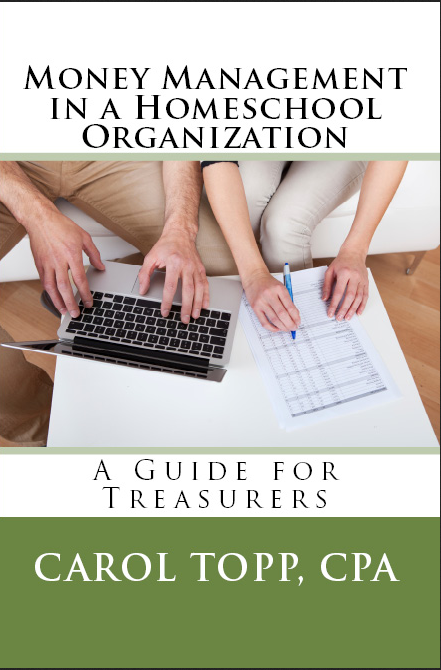
I hope you don’t ever face a similar situation.  To prevent fraud in your homeschool group, follow the practices mentioned above and in my book Money Mangement for Homeschool Organizations which you can order from the Bookstore page.

Carol Topp, CPA

Handling funds for big events like a senior formal

November 8, 2009

Hi Carol,
I’m the Treasurer for our local Home School Co-op and we are in the process of implementing some policy and procedures. My question is: What would be an effective policy for the handling of funds received by the various age-level activity coordinators?
Some activities are free or have a very small fee, while others are big events with tickets being sold and expenses incurred (High School Formal)..  Should there be a set amount that does not need to flow through the checking account and the coordinator be responsible for the collection of fees and the disbursement of funds, or should all monies flow through the checking account and expenses paid by the Treasurer?
Thank you,
Terri K
Terri,

Excellent question!

In general, I recommend that all activities under your co-op flow through your organization’s checking account. It might make more work for the treasurer, but it provides accountability and oversight of the program that will bear your name.

That being said, I am treasurer of a separate graduation ceremony fund for my homeschool group.  We (the parents of the graduates) set up a separate checking account just for the graduation ceremony.  I believe it was so that only the parents with graduates were funding the graduation, not the entire student body/homeschool group.  We have to stay on budget because there is no “slush fund” from the larger group to fall back on if we overspend.

There is no set amount to help you make a determination.  I would base my decision on the nature of the activity.  If it is recurring (like our graduation ceremony) then perhaps a separate account could be set up; if it is only a one-time event like a field trip, then keeping income and expenses part of the larger group’s system would make sense. Also consider the fiscal responsibility of the leaders of your separate activity.  If no one cares to handle the money in a responsible manner, then don’t let them open a separate account.

I hope that helps!

Carol Topp, CPA

Banker wants IRS letter to open a checking account

September 28, 2009

Hi Carol,

At your leader meeting a few months back, you had recommended that all of our groups have the same EIN number.  When a group leader tried to change their account to one using our EIN, the banker wanted a copy of our original letter from the IRS.   I told the banker that we have never had to provide anything except a letter from me (one who obtained the number in 2002) and the EIN number which we provided.  He said it was just a personal preference of his.  Have you heard of this?  I am uncomfortable doing more than what is usually required and providing personal paperwork to him.  Am I being unreasonable, or do you think it is okay to provide it?   Thanks for any insight.

Debi in Indiana

Debi,

I’m with you-the banker should not need an IRS determination letter (I assume that’s what’s he is talking about) to open a nonprofit checking account. Many nonprofits never get a tax exempt determination letter from the IRS because they remain very small.

Don’t believe the banker if he says an IRS 501c3 determination letter is required to open a checking account (fortunately he said it was his personal preference).  I once had a bank teller  tell me that nonprofits couldn’t earn interest on their savings accounts because they were nonprofit!  She was greatly mistaken. Bankers don’t always know what they are talking about (outside of banking…)

Carol Topp, CPA

Debi followed up my reply with the following

I think there is some confusion on what the bank manager is asking for.

I don’t think he is asking for us to prove that we are a 501c3 non-profit as recognized by the IRS. I think that all he wants is a copy of the letter from the Department of the Treasury that assigned us the EIN number. He probably doesn’t even know the right terms for what he is asking.

Yes, I think you are correct.  The banker may have only been asking for the EIN paper from the IRS, not a 501c3 determination letter.
I guess he’s being careful about getting the EIN correctly from the IRS letter itself.  I can’t blame him for that.

Carol Topp, CPA

Getting an EIN (Employer Identification Number)

June 18, 2009

Hi Carol,IRS

I am new to an existing homeschool co-op in VA. This co-op is more than 12-15 years old. We do not accept donations or need to; so far we have been handling the money through someone’s personal bank account. We receive fees from students and then pay teachers and reimburse them for materials, generally we break even each year (or can if we need to). There are regular Board meetings; I do not know if they have bylaws or take minutes but I do know they have a mission statement. The bottom line is that we want to be able to have a business checking account.

Can we get an EIN in order to open a checking account in our co-op name without incorporating and without having a state or federal annual filing requirement? I seem to remember that once you get an EIN (that I think is required for a business bank account), you are on the radar screen with the IRS and will need to file some sort of return.

Thanks so much

Nancy V in VA

Nancy,

Usually the first contact a homeschool organization has with the IRS is getting an Employer Identification Number (EIN). Most banks now request an EIN when a group opens a checking account. Your group is doing things right by getting a checking account for their co-op instead of using a personal account.

On my website, www.HomeschoolCPA.com you can read my article Getting an EIN from the IRS.

Yes, you can get an EIN for banking purposes, but not have any other dealings with the IRS. You do not have to be a nonprofit corporation to obtain an EIN. If your organization does incorporate later, they will need to apply for a new EIN.

You will deal with the IRS if you become a 501(c)(3) tax exempt organization or pay workers. Since you mentioned that you are paying teachers, then you have required reporting to the IRS and to your state. You will have to pay payroll taxes (Social Security and Medicare) and file a W-2 if they are employees or file a 1099MISC if they are independent contractors. You should read this entry: “Paying co-op teachers is a sticky issue.”

Best of success to you!

Carol Topp, CPA

Checking accounts and EINs for homeschool groups

June 4, 2009

Carol,

We have always had a checking account under a parent’s name. We were adding a name to our account this year when (the bank) informed us we can no longer do this and we need to have our own Tax ID number. Will we need to file returns with the IRS if we get a tax ID number?

I strongly discourage using a parent’s name on an organization’s checking account. The organization should have a checking account in its own name and use an Employer Identification Number (EIN), not an individual’s social security number.

Getting an EIN from the IRS does not necessarily mean your organization will have to report income to the IRS. If you are a small nonprofit organization with annual gross revenues under $5,000, there are usually no reporting requirements to the IRS at all.

Nonprofits have to start filing tax forms when they

  • bring in more than $5,000 a year
  • become a 501(c)(3) tax exempt organization
  • do public solicitations (i.e. door-to-door selling or fund raising)
  • pay workers either as employees or independent contractors

Money_thumbnailIf you hire and pay workers, your organization will use the EIN to file either 1099MISC or W-2 forms for each worker.

Read more about hiring and paying workers in my ebook, Money Management for Homeschool Organizations here

Carol Topp, CPA