Does a nonprofit need to file any tax returns before they apply for tax exempt status?
August 20, 2010
I was advising a small homeschool organization about applying for tax exempt status and explained that they had 27 months after their date of formation to file an application with the IRS.
Hi Carol,
I just read this and was concerned that I would need to file something during the 27 months time frame. Please explain if possible.
http://www.irs.gov/charities/article/0,,id=156389,00.htmlTeri
Teri,
The link to the IRS website concerns IRS requirements before you apply for tax exempt status. The link above states this (in part)
Tax Law Compliance Before Exempt Status Is Recognized
An organization that claims tax-exempt status under section 501(a), but has not yet received an IRS letter recognizing exempt status, is generally required to file an annual exempt organization return.
This is a fairly new requirement from the IRS. I used to tell nonprofit organizations that if they had not yet applied for 501c3 status, they did not have to file the Form 990. It came to my attention only a week ago that the IRS wants Form 990 from all nonprofits.
Fortunately, the form your organization (and all small nonprofits with annual gross revenues of less than $25,000) would need to file is the 990N, an electronic postcard that asks about 5 questions: Name and address of organization, the principle officer’s name and check a box that your annual gross revenues are under $25,000. It is very short and would take less than 5 minutes once a year.
Here’s a blog post that answers your question. http://homeschoolcpa.com/does-new-irs-990n-apply/
I hope that helps.
Carol Topp, CPA
Should your homeschool group be a 501c7 social club?
August 16, 2010
Your website has been very helpful, but I would like to ask you some questions. Now that we have the EIN are we required to file for any type of status? Are we going to have to fill out any IRS forms yearly or be responsible for any tax payments?Also, when I applied for the EIN I listed us as a social organization because I thought that described our group better than the other choices since we only meet so that our families can socialize and enjoy activities together; was that an accurate description or do homeschool groups classify as something else? Any insight you have on our situation would be much appreciated.Sincerely,Catherine R in Alabama
I’m glad my website was helpful. It sounds as if your getting your group onto the right track.
Here’s a blog post that you might find helpful: Will getting an EIN put us on the IRS’s radar?
Many homeschool groups classify themselves as nonprofit educational organizations because they are co-ops or offer educational activities like classes and field trips. A support group could be considered a social club as you chose.
I have helped homeschool organizations apply for tax exempt status with the IRS several times. Homeschool groups typically apply for 501c3 status as an educational organization, but a few apply for 501c7 status as a social club.
I briefly discuss the difference between a 501c3 educational organization and a 501c7 social club in this article:
A more in depth explanation of 501c3 and 501c7 status can be found in my book Tax Exempt 501c3 Status for Homeschool Organizations. Order the book here.
Can a small group be an IRS qualified charity?
August 1, 2010
In the past week, I have received two emails from homeschool leaders in MD and CA with a surprisingly similar situations.
In both groups, a small number of homeschooling families were joining together to hire a single teacher to teach their children once or twice a week. Both groups were very small, only seven families total, but they were paying each instructor quite a bit of money-$11,000 annually in one case and $17,000 in the other. This meant that they exceeded the IRS threshold of $5,000 annual gross revenue and needed to consider filing for 501c3 tax exempt status.
They had several concerns such as a contract with the teacher, how should the teacher be paid and could the group qualify for 501c3 tax exempt status as an educational organization?
Here were some of their questions:
I found your website and found it to be most interesting and helpful to homeschool co-ops. I would like to schedule a personal consultation with you. I am part of a homeschool group that informally hired a teacher to teach certain classes in past years, but this coming year the teacher wants a contract.
Rosemary in MD
I saw your website and had some general questions for you. Appreciate your ministry to homeschoolers. We are trying to decide whether our group should be a sole proprietorship owned by person or try to establish a nonprofit. What would be the pros and cons of each? What if we can’t afford to file for tax exemption at this time? What are our choices if our gross receipts are around $11K/year?
Teri in CA
There are several options for homeschool organizations who are trying to decide how to structure themselves. I advised the leader from CA to read this article:
I offered a private phone consultation and discussed the concerns and options with the leader from MD. I explained that I doubted the IRS would grant 501c3 “qualified charity” status to a group with only seven families. An IRS qualified charity is supposed to serve a public good, not the needs of only seven families.
Instead of pursuing 501c3 tax exempt status, we discussed that the hired teacher is really running a for-profit business (a sole proprietorship) with seven families as her customers. I shared with her several sample contractor agreements the teacher could use in her business.
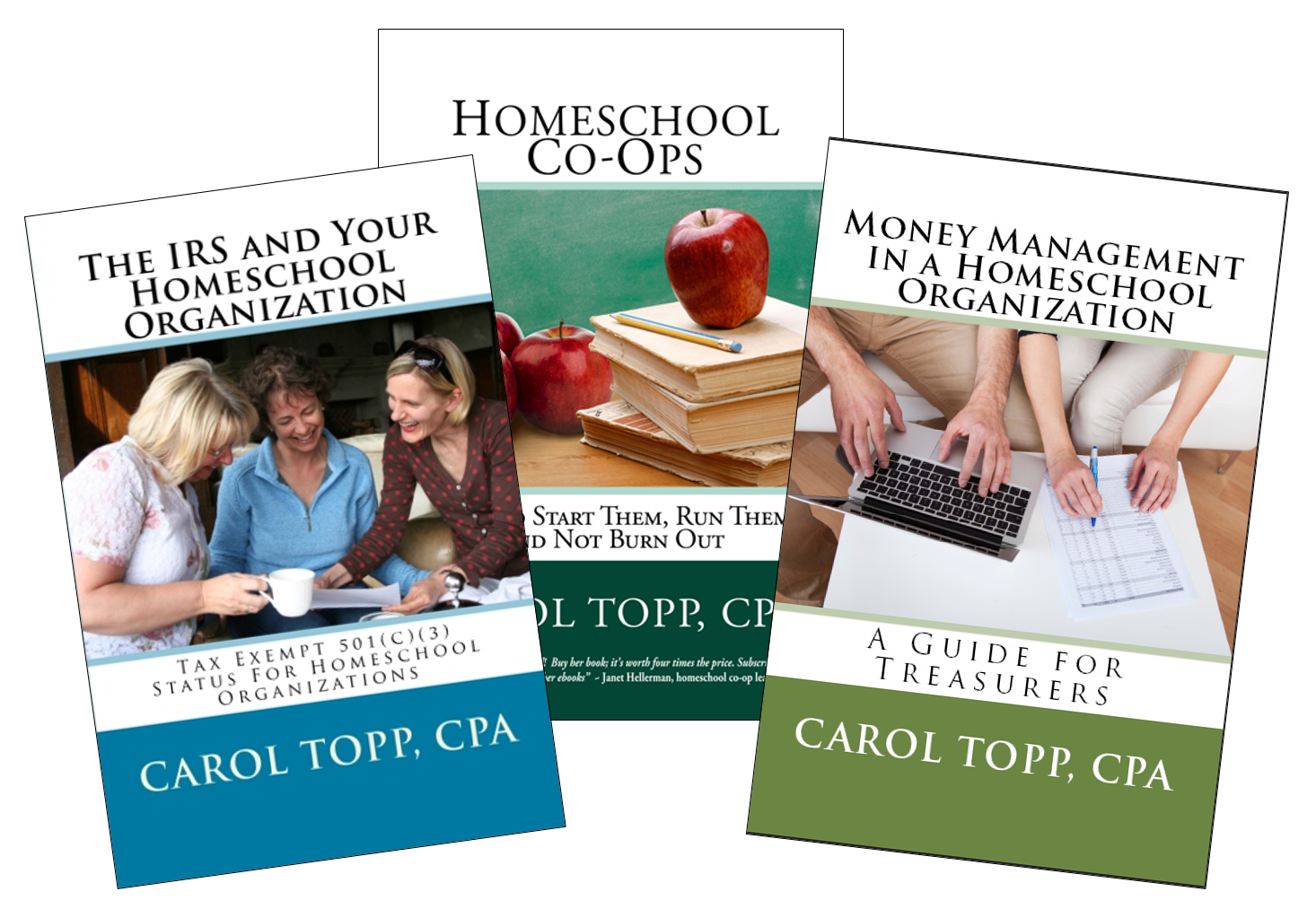
There is a sample contractor agreement available in my ebooks Money Management in a Homeschool Organization and Paying Workers in a Homeschool Organization.
Thank you again for the consultation. It answered a lot of questions for me, and I appreciate your support. Thank you also for the contractor agreements – I have been reading through them.
Rosemary in MD
If you have a unique homeschooling situation and would like to schedule a private consultation with me, please send me an email at Carol@HomeschoolCPA.com. Tell me a little about your group and we can arrange a mutually convenient time to talk.
Carol Topp, CPA
IRS delays Cyber Assistant (again)
July 16, 2010
On May 7, 2010 the IRS announced it would be delaying the release of the on-line program Cyber Assistant. This long-promised software will allow charitable organizations (including homeschool organizations) to file for 501c3 tax exempt status on-line. The IRS had previously announced that the filing fee would be lowered from $400 (or $850 depending on the organizations annual revenues) to $200 for organizations that filed using Cyber Assistant.
I had several homeschool organizations that were hoping to save $200-$650 by using the on-line filing option. Unfortunately, it won’t happen in 2010. When will the on-ling filing option be available? No telling. The IRS is not offering a new timeline.
What should your group do now if they want to apply for 501c3 tax exempt status?
Sandy Deja of 501c3Book.org has some good advice (emphasis added by me):
A 501(c)(3) has until the end of the 27th month after it is created to file its exemption application. If your organization is closing in on the end of its 27 month grace period, you should not wait for the Cyber 1023. Avoiding the hassles of missing the 27 month deadline is definitely worth the extra money.
Delayed 501(c)(3) Benefits
501(c)(3) status offers a number of benefits other than exemption from Federal income tax: deductibility for contributions, bulk mailing permits, state, local and property tax exemptions, and eligibility for foundation grants, to name a few. Only you can weigh the $650 discount against the costs of postponing these valuable benefits for your group.Reputation
In some cases, lost benefits can be recouped once the IRS recognizes 501(c)(3) status. There is one benefit, though, that once lost may be gone forever: your non-profit’s reputation. If you think there is any chance your organization will be in the news sometime soon, don’t wait for the Cyber 1023. Savvy journalists check the IRS website when writing articles about local charities. A news story pointing out that your group has not yet taken care of its IRS paperwork can do lasting damage.
So, in summary, take a look at the date you incorporated as a nonprofit within your state. If you are getting close to the 27 month window, your organization should file for 501c3 tax exempt status now and not wait for the IRS to offer their lower fee by filing through Cyber Assistant.
I can help with your 501c3 tax exempt application. See my Services page for details.
Carol Topp, CPA
Hosting a booth at county fair makes history
July 14, 2010
The San Diego Christian Homeschools hosted an information booth at the San Diego county fair. It was the first time in the fair’s history that a homeschool organization had been featured there.

Leader Lisa Vaca, wrote to tell me about it:
I just wanted to share with you about how blessed we were to be able to host a homeschool information booth at our County fair yesterday. This all happened thanks, in part, to the encouragement and tips of you, Kristen and Denise (of HomeschoolGroupLeader.com) , and thanks to the huge help of Carol with our non-profit filing last year. (You’re very welcome!)
Our booth was a big hit and the organizers of the non-profit booths at our County fair are begging us to return again next summer. We were able to get HSLDA and other homeschool organizations to send us brochures and publications to hand out, plus we got some of our SDCH kids involved in the photography and displays.
Through this Homeschool Info Booth we were able to introduce homeschooling to our community in a fun, new and positive way, and answer the public’s many questions about home education.


Isn’t that a great idea? The San Diego Christians are reaching out to others in their community to share the benefits of homeschooling.
Carol Topp, CPA
P.S. The San Diego Christian Homeschoolers obtained 501c3 tax exempt status (with my help) which gives them extra credibility in the eyes of their community. Learn the benefits of 501c3 tax exempt status for your homeschool group in this article Do we need 501c3 status?
Small homeschool groups receives official IRS Letter without 501c3 status
June 16, 2010
Hi Carol,
I know I’ve come across this information on your site before, but can’t find it today. I am a leader for a smaller homeschool support group (50 families). Each year, only about $1,000 passes through our bank account. I have obtained an EIN so we can open a bank account but we are also interested in non-profit status. The main reason for this is so people can make contributions and also so we can avoid paying sales tax. I read on the IRS site that we do not need a form 1023 if we have less than $5,000 annually. If that is the case, how do we prove our non-profit status?
Thank you so much for your help. Your site has been very helpful to us.
Shelley T, Illinois
Shelley,
Good question. I decided to call the IRS Tax Exempt Division on your behalf. First, Mrs Baker, the IRS employee said that you would have no proof of tax exemption because you do not have the IRS determination letter. That’s the letter the IRS gives nonprofits after their tax exempt application (Form 1023) is approved.
Then she mentioned that the IRS can send a letter stating that some nonprofits such as yours are small enough that they are not required to file Form 1023. I asked for that letter to be mailed to you. That’s the closest thing you’ll have to “proof.” At least it will be from the IRS and addressed to your group.
I found your mailing address on your website. Good thing you had an EIN, too. She verified the mailing address I gave her with your EIN.
Look for the letter in 10-14 business days.
Carol Topp, CPA
Follow up: Shelley received her letter from the IRS 14 days later. It simply stated “We have no record that your organization has been recognized as exempt from federal income tax.” It went on to explain the IRS forms and publications to apply for tax exempt status. The letter closed with a paragraph explaining that “an organization organized and operated exclusively for 501(c)(3) purposes…does not have to file for exemption unless its annual gross receipts are normally more than $5,000.”
Advice to homeschool leaders:
If you are a small homeschool nonprofit (gross revenues under $5,000 a year), and desire a letter from the IRS explaining that you are tax exempt, do what I did for Shelley and call the IRS. Request a letter explaining the exemption for filing a Form 1023 for small nonprofits.
If your homeschool organization brings in more than $5,000 a year, it is time to apply for tax exempt status with the IRS (or time to start paying tax on your surplus!). Read more here:
Questions? Send me an email. I can help!
Carol Topp, CPA
IRS starts revoking tax exempt status May 17
May 16, 2010

Homeschool leaders, if your organization has 501c3 tax exempt status be sure to file your annual Form 990N, 990 EZ or 990 or risk losing your tax exempt status. The IRS is beginning automatic revocation of tax exempt status May 17, 2010.
From USA Today:Hundreds of thousands of small non-profits, from Little League teams to community soup kitchens, could lose their tax-exempt status on Monday because of an IRS filing requirement.The 2006 Pension Protection Act included a provision requiring all non-profits to file an annual return with the IRS.
Previously, non-profits with annual revenue of less than $25,000 were excluded. Non-profits that fail to file a return for three consecutive years lose their tax-exempt status. On May 17, the three-year clock runs out for non-profits that haven’t filed a return since 2007.
The Urban Institute estimates that up to 365,000 non-profits could lose their tax-exempt status if they fail to file by Monday. Groups that miss the deadline will have to apply for a new exemption and pay a user fee of up to $850. They could also be liable for taxes on any revenue earned before their exemption is renewed.
The requirement does not apply to churches or church-related operations.
Non-profits with less than $25,000 in annual revenue can file a 990-N, an abbreviated online form. Completing the online form takes less than 10 minutes, says Tim Delaney, president of the National Council of Nonprofits.
What should you do if your organization loses its tax exempt status? The IRS says you will need to reapply for tax exempt status.
The IRS as a FAQ page.
And I can help. I assist homeschool organizations with tax exempt applications. See my Services page for details.
Carol Topp, CPA
Can a homeschool be tax exempt and obtain grants?
October 5, 2009
Dear Carol:
I am interested in writing proposals for grants for my family’s home school. As an individual home school, not as a home school support group, I want to apply to receive small amounts of money for travel, museum entry, art gallery entry, books, posters, etc. More often than not, I find this statement :“All applicant organizations or sponsoring agencies must be exempt from federal taxation under the Internal Revenue Code Section 501, in order to be eligible for funding.”
What do I have to do to have our home school be exempt from federal taxation?
Thanks.
Nancy H., Mississippi
Nancy,
You asked an excellent question. You are correct that many fund raising organizations now require 501c3 tax exempt status. Some homeschool groups want to become 501c3 tax exempt organization just so that they can participate in some fund raisers. I have a homeschool co-op as a client right now applying for 501c3 status.
A private individual or family cannot be a 501c3 tax exempt organization. The reason is that the IRS does not allow tax exempt organizations to offer private benefits or what they call “inurement” (meaning to become beneficial or advantageous) to individuals. Tax exempt organizations must benefit a group, preferably the general public.
I have been asked your question before so I wrote about it on my blog. Here’s the link: Can my family’s homeschool be a nonprofit?
You might also read my blog entry on doing a family fund raiser: Can my individual homeschool have a fundraiser?
I hope that helps!
Carol Topp, CPA
Off to Home Educators Assoc of Virginia (HEAV) Convention
June 10, 2009
For the next few days I will be at the Home Educators Assoc of Virginia (HEAV) Convention in Richmond, VA.
They have a pretty busy schedule for me. I’ll be giving workshops on:
- Budget Is a Dirty Word: Money Management for Those Who Hate to Manage Money
- Wanna Be a WAHM? The Pitfalls and Possibilities of Being a Work at Home Mom
- Small Business for Teenagers
- Is Your Homeschool Group Ready for the Next Step? Becoming a 501c3 Tax-Exempt Organization
- How to Start and Manage a Homeschool Organization: Boards, Budgets, and Bylaws
(see full descriptions of the workshops here and get the handouts here)
I’ll also be attending the homeschool leaders lunch and I am serving on a Q&A panel for leaders. I hope to meet some of you.
If you’ll be at HEAV, come by my booth #237 or to a workshop and say hello!
Carol Topp, CPA
Does new IRS 990N apply?
April 21, 2009
Hi Carol,
Thanks so much for all your help in getting our Christian Homeschool Network up and running. Things are going well so far. My husband brought a card he saw at the post office and handed it to me thinking it might apply to our group. The same basic info is on this web site: http://www.irs.gov/charities/article/0,,id=169250,00.htmlIt is about a new filing requirement for small tax exempt organizations.Does this apply to us? I was unsure if this was just for 501 C 3 organizations.
Thanks, Carol
Sharon W
Sharon,
The new IRS ePostcard (Form 990N) notification is for 501c3 organizations. The IRS is trying to clean up its database by using this short electronic postcard. They hope to find any “dead” nonprofits that are no longer in operation. They are also looking for small nonprofits that have “grown up” to the $25,000 gross revenues per year and should be filing a 990EZ or 990 Form annually. The ePostcard is a way for small nonprofits to acknowledge that they are still under the $25,000 annual revenue threshold for filing the 990.
I recommend that you consider 501c3 status ASAP. The IRS expects nonprofits to file for 501c3 tax exempt status with in 27 months of formation (incorporation as a nonprofit). Your nonprofit incorporation date was May 27, 2008, so you have until August 2010 to apply. Otherwise, the IRS requests an explanation of why tax exempt status was not filed earlier and tax exemption is granted to the date of filing, not back to the date of formation. This could mean that a nonprofit might owe back income tax for the period that they were not tax exempt.
If your gross revenues stay under $5,000 a year, you are granted an exception from filing the paperwork for 501c3 status. If gross revenues get to be over $5,000 a year, your group should file for 501c3 tax exempt status or pay corporate income tax on any surplus (i.e. profit).
In a nutshell, a small nonprofit has three choices:
1. Stay under $5,000 gross revenues per year
2. File for 501c3 tax exempt status
3. Pay corporate income tax on any annual surplus.
I hope that helps,
Carol Topp, CPA
Update as of August 2010:
The IRS is now asking all nonprofit organizations to begin filing the Form 990N , even if they have not yet applied for tax exempt status. Here is what the IRS states on their website http://www.irs.gov/charities/article/0,,id=156389,00.html
Tax Law Compliance Before Exempt Status Is Recognized
An organization that claims tax-exempt status under section 501(a), but has not yet received an IRS letter recognizing exempt status, is generally required to file an annual exempt organization return.
The annual return is either Form 990, 990EZ or the new electronic postared Form 990N.
Carol Topp, CPA